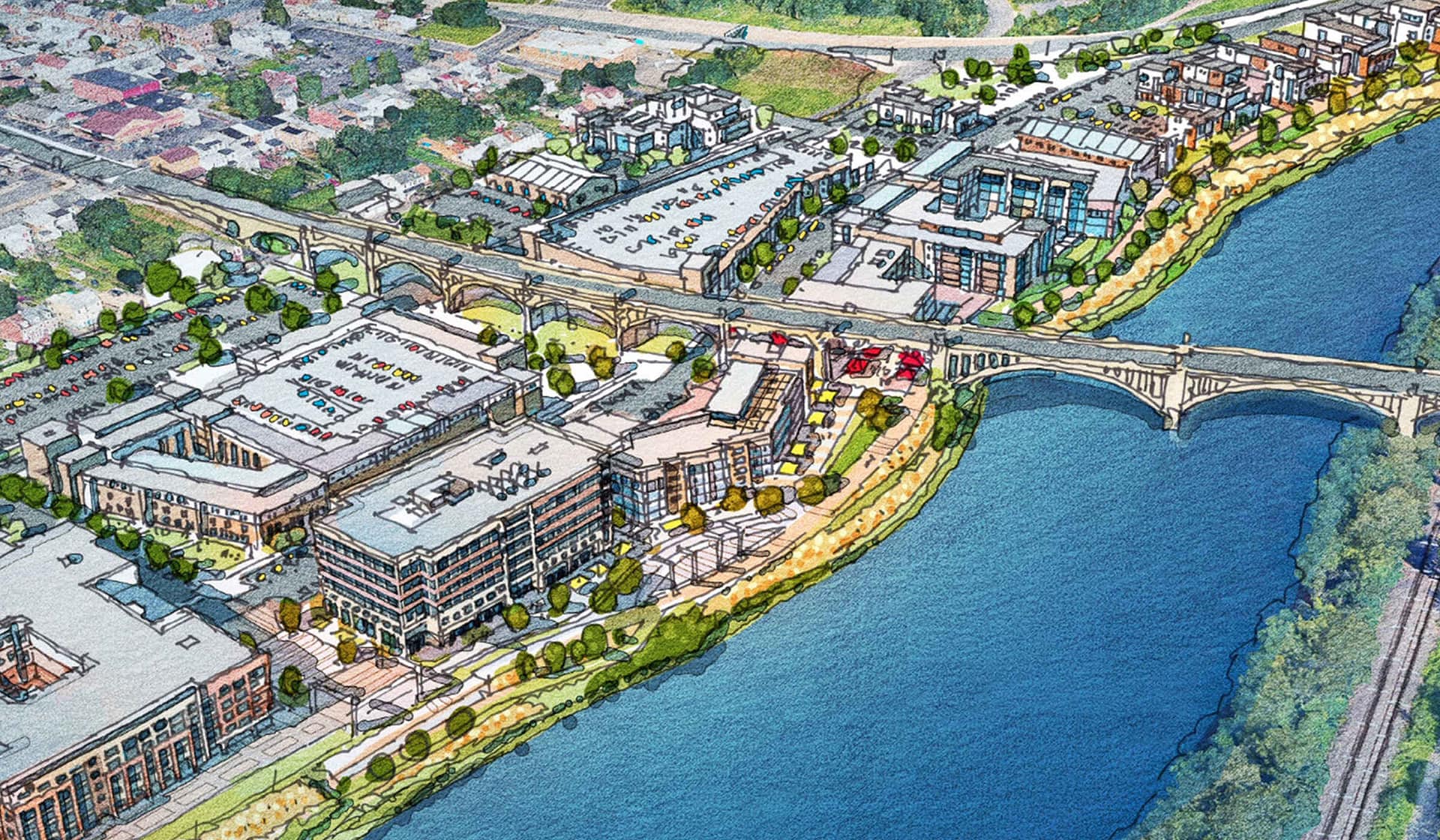
Allentown, Pennsylvania, January 20, 2026. The Waterfront Development Company has completed a comprehensive update to the long-term master plan for The Waterfront, the 29-acre riverfront district on the western bank of the Lehigh River. The new plan reflects a decade of learning, an honest assessment of the post-pandemic market, and a renewed commitment to a place that has served Allentown and the Lehigh Valley for generations.
The first plan was right for its time. Conceived in 2012 to make the most of the Neighborhood Improvement Zone (NIZ), The Waterfront was designed as a largely office-driven campus, supported by residential, structured parking, and street-level retail. The market has since moved.
What changed in the market
Over the past three years, office demand across the Lehigh Valley has slowed and shifted toward smaller, flexible footprints. Residential demand has held firm, with regional multifamily vacancy in the low single digits, and new supply absorbed about as fast as it arrives. Retail and dining in walkable settings have outperformed conventional formats, and the region’s population, workforce, and household incomes have kept growing. A plan drawn in 2012 should answer the market of today.
A national search and a market-tested process
In 2025, The Waterfront Development Company began a full master planning effort to future-proof the site. After a national search, it selected Urban Design Associates (UDA), a planning and urban design firm based in Pittsburgh with more than 60 years of work shaping mixed-use, waterfront, and downtown districts. UDA’s process is built on market reality, community input, and long-term flexibility.
Through 2025, a market study examined trends in multifamily, retail, hospitality, and office sectors at the regional and national levels. The findings were direct: housing is the strongest and most durable driver of activity; office must be right-sized and specialized; and the best places blend daily life, commerce, and public space into one whole. UDA turned the findings into working concepts backed by physical models, height and massing studies, and case studies, then tested them through virtual meetings, site visits, and in-person workshops with residents, City of Allentown leadership, local businesses, and regional partners.
What the new plan does
The updated plan is at once disciplined and ambitious. It increases the residential component, adding a mix of apartments and for-purchase townhomes that draw on Allentown’s architecture and answer the region’s housing needs. These homes are designed to support a true 18-hour neighborhood, one that stays active well beyond the workday.
Office is scaled back and refined toward high-quality, flexible space for growth sectors such as healthcare and professional services, as well as for users who value proximity to amenities and talent. Retail, dining, and entertainment are expanded to activate the riverfront, support local businesses, and complement downtown Allentown rather than compete with it.
Public space sits at the center. New riverfront connections, trails, and civic gathering spaces are designed to tie Allentown to the Lehigh River, a priority residents named again and again. Parking and infrastructure are treated as adaptable systems, so the site can change as transportation and uses change.
Built to adapt
This is a master plan, not a final set of construction drawings. The concept has been vetted, tested, and refined, and now moves into detailed work with civil engineers, architects, designers, and municipal partners on coordination, permitting, infrastructure, and phasing. The plan takes on the concerns large projects often raise: traffic, scale, neighborhood fit, affordability, and access to public space, by prioritizing walkability, distributing density with care, phasing responsibly, and designing places meant to be shared.
“This plan is about balance,” said Zachary Jaindl. “Between past and future. Between market realities and civic ambition. Between private investment and public benefit. We listened carefully, and we designed with intention.”
Fully realized, The Waterfront will deliver new housing, jobs, local-serving retail, public river access, and a year-round destination that strengthens Allentown’s tax base and quality of life, while staying flexible enough to adapt to what comes next. The Waterfront is entering its next chapter, with the Lehigh Valley’s future in mind.
See the vision for the district. Explore the Residences and the Offices. Schedule a visit.